Available for Lease
Amenities

  Facts and Features  Mills Building History


  Darius Ogden Mills  Construction
Facts and Features
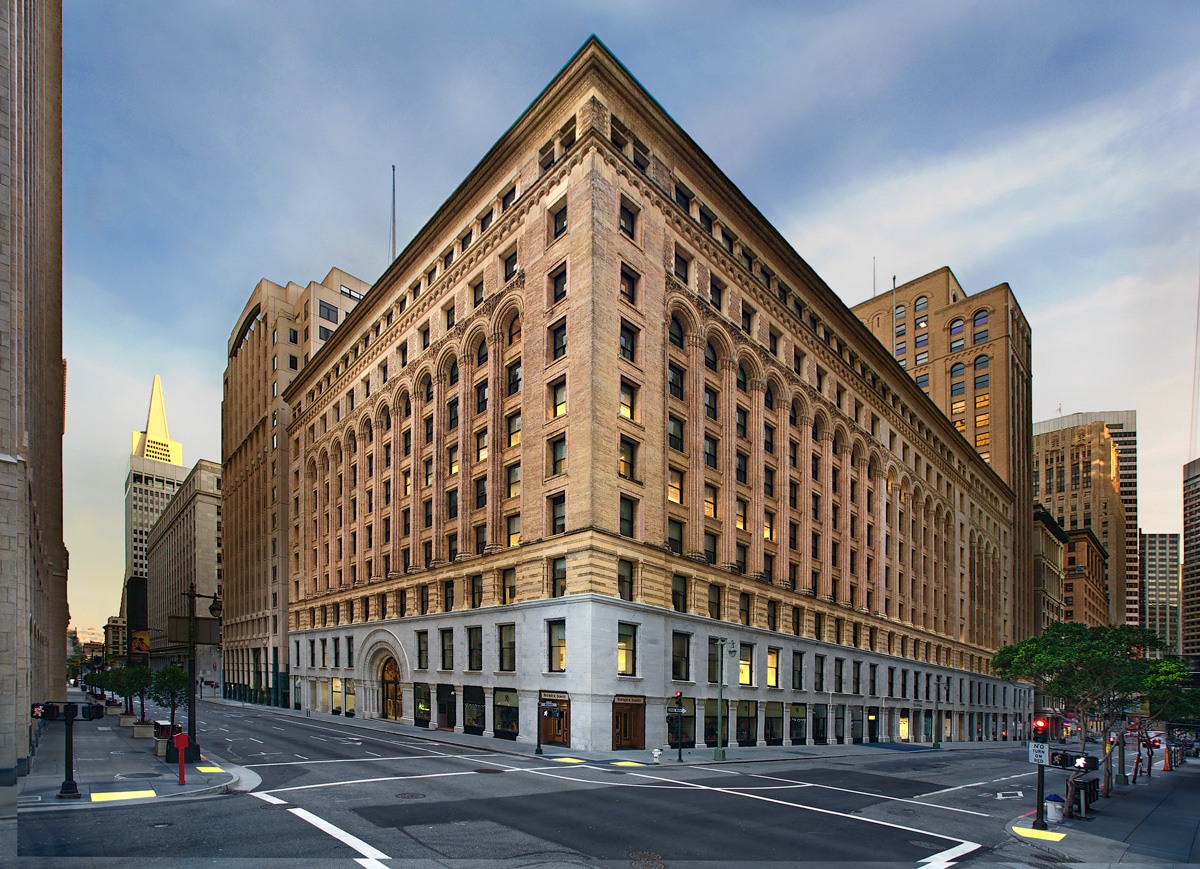
The Mills Building is a San Francisco landmark with singular historical, architectural and aesthetic interest. Darius Ogden Mills, one of San Francisco’s early financial tycoons, commissioned it. In 1840 Mills started the National Gold Bank of D.O. Mills & Company, the first bank west of the Rocky Mountains, and helped to finance the construction of the Southern Pacific Railroad. His bank later merged with the California National Bank, and upon moving to San Francisco in 1864, Mills helped form and became president of the Bank of California.

When Mills commissioned his building in 1891, he chose what was, in its time, a revolutionary style of architecture. Burnham and Root of Chicago designed the 154-foot, steel frame skyscraper. The Mills Building is San Francisco’s only remaining example of this Chicago School of architecture, outlasting the old Chronicle Building at Market and Kearny, which has been entirely modified, and the Crocker Building at Post and Kearny, which was torn down in 1967.

The Mills Building survived the 1906 earthquake, although its interior was virtually gutted by the ensuing fire. Architect Willis Polk oversaw the building’s restoration in 1907, adhering to its original design. Additions made in 1914 and 1918 also maintained the building’s stylistic integrity. The last addition, the 22-story Mills Tower, was completed in 1932.

The first two stories of the Mills Building are constructed of white Inyo marble from Keeler, California. The building’s most distinctive feature is its Montgomery Street entrance arch, which typifies the Richardson-Romanesque style. Its carved acanthus leaf and egg-and-dart molding frames four pairs of marble Corinthian columns.


Needing only minor restoration after the earthquake and fire, the curved staircases in the Montgomery Street lobby are of the original Jaune Fleuri marble. The lobby interior features black Belgian marble and lavish Roman travertine, as well as an inlaid marble floor pattern which was added during a renovation of both lobbies in 1988.


Mills Building History
The Mills Building is an excellent example of Chicago School design by one of Chicago’s most important firms (Burnham and Root) during the heyday of the early skyscraper. The Mills Building was one of the tallest in the city at the time it was built and for many years afterwards. Seriously burned in the 1906 fire, it was rebuilt and enlarged by D.H. Burnham and Co., with Willis Polk in charge. Polk extended the building again in 1914 and 1918. In 1931, the 22-story Mills Tower by Lewis Hobart was erected at the rear of the building in an excellent adaptation of the original design.

From 1883 to 1893, Chicago architects were engaged in an architectural revolution at a frenzied pace. It was the infancy of the skyscraper. However, it was not merely the heights of the buildings that mark the era, for by today’s standards they were modest. But as important as the heights was the architectural treatment of these structures. The solutions generated were frequently as innovative and imaginative as the use of the steel frame, rather than masonry, for support of the structure.

One of the Chicago pioneer in the use of steel frame (which was originally used only for the interior frame with exterior bearing walls of masonry) was William LeBaron Jenny who trained as an engineer before becoming an architect. In the early 1870’s, he employed Louis Sullivan, mentor of Frank Lloyd Wright, and among others later employed there were Daniel Hudson Burnham and John W. Root.

Of the first three steel frame buildings in San Francisco, only the Mills Building remains essentially indistinguishable from its original state. Its stature is heightened because of its direct tie to "The Chicago School."


The Mills Building consists of four parts. The original square which occupies a frontage of 159.5 feet on Montgomery Street and 137.5 feet on Bush and was previously the site of Platt’s Music Hall one of the more celebrated places of assembly in the city.

The building did suffer some minor damage to the exterior in the 1906 earthquake and the entire interior was badly damaged by the fire. Reconstruction, undertaken in February 1907, is attributed to Willis Polk. This addition was 70 feet in width along Bush Street and rose the full height of the original building. In 1914, a five-story addition, 68.5 feet in width, followed and in 1918, the sixth through tenth floors were added.

The last addition of the structure, the Mills Tower, occurred in 1930-31. The architect for the tower was Louis Parsons Hobart who adhered to the detailing of the first three floors of the original design for the tower base, and applied modified, but compatible, façade treatment for the 19 floors above.

The Mills Building’s most distinctive feature is its Montgomery Street entrance. The two-story archway is elaborately carved in the classical acanthus leaf and egg-and-dart motif, with carefully chiseled faces at the tops of each of the Corinthian columns, which form the base of the arch.

On April 23, 1975, the Mills Building and Tower was designated a historical landmark with preservation status by the Board of Supervisors of the city of San Francisco.

In 1988, the two main lobbies of the Mills Building ware connected and an arcade was created where once retail tenants occupied space. The arcade was specifically created to provide space for rotating, museum-quality art exhibitions and to create a more attractive passage from one lobby to the other.


Darius Ogden Mills
Darius Ogden Mills, born September 5, 1825, in North Salem, Westchester County, New York, was the son of James and Hannah Mills, both descendants of early American stock. In 1840, Darius Mills started a bank, the National Gold Bank of D.O. Mills & Company, which has the distinction of being the first bank west of the Rockies and later helped to finance the construction of the Southern Pacific Railroad. The bank would later merge with the California National Bank; and in 1864, upon moving to San Francisco; Mills helped form and become president of the Bank of California.


Construction
The Mills Building consisting of approximately 450,000 square feet

"Building" has 10 stories "Tower" has 22 stories

Constructed in 1892, restored after the 1906 earthquake in 1907

Additions to the Building made in 1914 and 1918, last addition of the 22-story Tower was completed in 1932.

Construction Type: Steel & Concrete

Partially sprinkler

Heating – steam heat

Operable windows

450 KW Emergency Generator


Copyright © 2009 The Swig Company, LLC. All Rights Reserved.
Privacy Policy | Terms of Use